Wednesday February 26
Hard to believe that it is already more than two
weeks since we left home!
We have just arrived back in Esperance after a week
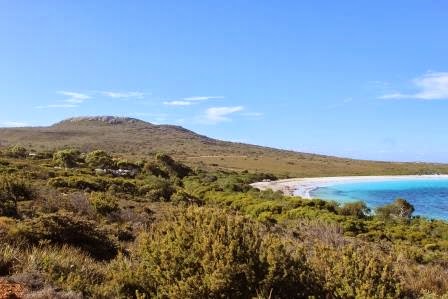
in Cape le Grand National Park, camped at the unbelievably beautiful Lucky Bay
and two days a bit further east at Cape Arid National Park. Lucky Bay is, as you can see below, just
‘picture perfect’ - no wonder so many people raved about it to us!
 |
| Lucky Bay |
 |
| Lucky Bay - look carefully for the caravans amongst the trees! |
 |
| More Lucky Bay |
 |
| Lucky Bay from the Rossiter Bay walk |
 |
| Lucky Bay again from the Rossiter Bay walk |
 |
| Just one more - the eastern side of the bay |
 |
| The view from our campsite |
 |
Celebrating our arrival in the first national park of
our trip - thanks Bron & Glen!!!! |
Apart from the snow-white silica sand, created by
erosion of the huge expanses of granite which seem to flow down in to the sea,
these parks are heathland ecosystems, which I have decided are a real favourite – a huge diversity of beautiful nectar-producing flora and amazing, tough plants adapted to survive
wind, sandy soils, salt and frequent drought.
Even though it is not ‘peak’ flowering time, the Banksia speciosa (Showy
Banksia) and at least three eucalypt species (beyond it being evident that two
of them are yates of some sort, the interpretive information available doesn’t
allow me to identify them, which is very annoying!) are flowering profusely so
the campground and surrounding areas are alive with noisy, aggressive New
Holland Honeyeaters and Red Wattlebirds.
We can also hear many other birds, but our lack of identification skills
and the excellent ‘keeping everyone else at bay’ skills of the honeyeaters
means that we are not sure what they are.
Happily though the Willy Wagtails and White-browed Scrubwrens hop all
around us and seem immune to their antics.
 |
| Showy Banksia |
 |
| New Holland Honeyeater feasting on the nectar in the eucalypt |
 |
| Insects are a valuable addition to the diet! |
 |
| White-browed Scrubwrens were a delight |
 |
| Munji flowers |
Some of the prehistoric-looking, semi-parasitic Munjis
(Western Australia Christmas Plant) still have flowers and the large seed
cases are also attractive in their own right, whilst a few of the mid-storey plants
are flowering as well. Would love to come back here in September and October,
when the weather would be much less appealing, but the flowers would be incredible.
 |
| Munji seeds |
 |
| A 'grove' of Munji |
 |
| Native Honeysuckle |
 |
| Verticordia species |
 |
| Eucalypt species |
Smallish monitors frequently wander through the camp and
cause the birds to launch into a frenzy of warning and scolding. I was amazed
one afternoon to watch a Red Wattlebird dive-bombing one of these potential
marauders and its attack was so effective that the monitor changed direction
completely.
A group of Western Grey Kangaroos also lives
around the campsite and they are, of course, very used to people and are often
to be found sharing the shade of campers' awnings.
They (and the birds) obtain their water supplies in this very dry
environment on the beach, as all along the front of the camp ground fresh water
seeps out of the sand and creates pools and rivulets amongst the piles of
seagrass and the sand. The drying seagrass
is obviously a food source as well, as the kangaroos forage amongst the large
piles on the beach
 |
| Lunch time! |
This certainly is the time of year to be here
though – temperatures in Perth have been over 30, but we have had around 24 for
most of the time and for three of the days at Lucky Bay the wind was very
strong and quite chilly.
Murray has done lots of walking – from Lucky Bay
to the next bay, Thistle Cove, to Rossiter Bay to the east and up Frenchman’s
Peak, which affords great views across the heathlands. He has also kept up his daily swims, with the
exact spot chosen to avoid being swamped by choppy seas and has managed a bit
of fishing, although this has been made difficult by the on-shore winds, so only one small Sweep has made it onto the menu. I have done a bit of walking,
but in deference to the still-healing leg, have been ‘sensible’ (I have come to
hate that word!).
 |
| Thistle Cove |
 |
| Whistling Rock, Thistle Cove |
 |
| One-sided Bottlebrush, Thistle Cove walk |
 |
| Thistle Cove walk |
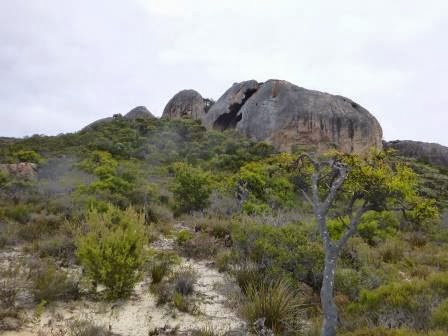 |
| Rossiter Bay walk. The holes in the granite were created by wave action when sea levels were much higher |
 |
| Frenchman's Peak |
 |
| Views from Frenchman's Peak |
 |
| More views from Frenchman's Peak |
 |
| Scott, Sally, Chelsea and Sami |
As always when travelling, we love the opportunities
it provides to spend time with some terrific people, especially in the national
parks campsites, as those who visit these places and are not concerned about
the ‘limited facilities’ tend to share our views on life (and if that sounds
pretentious, I will swap it around and say that we tend to share their views). At Lucky Bay we struck the jackpot with our
neighbours - ‘Syneysiders’ Sally and
Scott and their gorgeous girls, Sami and Chelsea, who are on a seven month trip
‘around’ Australia, and Julia and Selgai from Munich, who are spending a couple
of weeks here. We had lots of fun getting to know them all.
 |
| Julia and Selgai with Sal, Scott, Chelsea and Sami |
Cape Arid is also a beautiful place and on
arriving in the park on Monday morning a question that had occurred to me about
whether we were trying too hard to see ‘everything’ was quickly answered –
absolutely not! This is a different environment to that at Cape le Grand. Still
stunning beaches and rocky headlands, but the heathlands include extensive
stands of Showy Banksia which are flowering profusely and many large Grass
Trees, which have incredibly thick leaves. As the camp site is actually amongst
the banksia woodland, my collection of photos of WA flora has grown
exponentially. Oh dear – get the reference books ready Scott!
 |
| Yokinup Bay from Cape Arid National Park campground |
 |
| Thomas River and Yokinup Bay |
 |
| The campsite |
 |
| Grass Tree starting to flower |
 |
| Banksia speciosa (and bee) |
Following the obligatory swim and lie on the beach
on our first afternoon, during which we amused (wrong word really – their bites
are not particularly amusing) ourselves by providing many dead March Flies for
the local ants to cart back to their larders, Murray was very excited to catch
two Australian Herring from said beach - he had to abandon the rock fishing as
the local crabs were dining out handsomely on his bait!
 |
| Murray off for a swim! |
 |
| Our first taste of Australian Herring and very nice they were too! |
My clever plan to sit outside in the evening and
keep my eyes peeled for any of the local populations of nocturnal Honey
Possums, Chuditch and Quenda or Southern Brown Bandicoot which may have been
wandering about was quickly abandoned due to mozzie attacks - the minor disadvantage
of camping here near the Thomas River, which is not actually flowing into the
sea at this time of year. Any feelings
of disappointment were quickly put into perspective when I remembered that the
ever-present Camp Hosts had advised that my chances of seeing any of these
creatures were decidedly remote and that the Thomas River Estuary promised
opportunities to see even more wading birds than the Hooded and Red-capped
Plovers and Sooty and Pied Oystercatchers we had spotted as we walked down to
the beach. Mind you, as it is permissible to drive on the beach here, as has been the case with most of the beaches we have enjoyed thus far, and I would assume that it is highly likely that any of the identified endangered
birds which manage to lay eggs would have them squashed by some passing
4WD, it is incredible that we were seeing these birds at all.
 |
| Sooty Oystercatchers |
Our second day in the park was devoted to more
extensive exploration and we enjoyed the Len Otte Nature Trail, designed and
established by Len Otte, the first resident ranger in the park, in 1979. It was
the first nature trail in any WA national park. The interpretive brochure Murray had picked up
in Esperance was not as illuminating as it should have been as only two of the
original twelve stops described are now marked on the trail, but luckily our
ever-growing knowledge of the local flora, fauna and geographical features
allowed us to do our own interpretation. We even found ourselves remembering
important bits of information about heathland species that Alan Tinker had shared
when we were at Western Flora Caravan Park in 2012.
 |
| One of the many Zamia Palms (really cycads!) we saw |
 |
| Views to Yokinup Bay |
 |
| Feldspar intrusion in the granite gneiss - more questions which require explanation! |
 |
Hakea clavata - has the thickest leaves of any Hakea species and looks
very much like some sort of succulent |
A visit to the river before the all-important
morning coffee was very worthwhile as we saw a pair of Cape Barren Geese
feeding on some shrubs on the opposite bank.
Tuesday afternoon was spent walking along the
coastline to Dolphin Cove and as we traversed the many granite outcrops we were
astounded yet again by the amazing views and marvelled as always at the forces
of nature which have created this landscape. How we need a geologist travelling
with us to answer the myriad of questions which continually arise!
 |
| Dolphin Cove |
 |
| Looking back to the beach in front of the campground |
So here we are back in Esperance for just one
night, to stock up for our visit to Stokes National Park, catch up with
everyone and update the blog. We will spend two nights here before going on to
Fitzgerald River National Park. More
beautiful beaches and amazing heathlands to endure – we trust that you are
appropriately concerned for our well-being!


